Sizing
What Size Dumpster Do I Need? A Jacksonville Guide
The 20 yard is our most popular all-purpose size. How to pick between 10, 15, 20, 30 and 40 yards by volume, weight and space in Jacksonville.
Read the guidePermits · 10 min read
Two questions decide whether a container can go where you want it: does the city, county or state allow it in that spot, and who is allowed to haul there? Here is what each official source says, as read in October 2026.
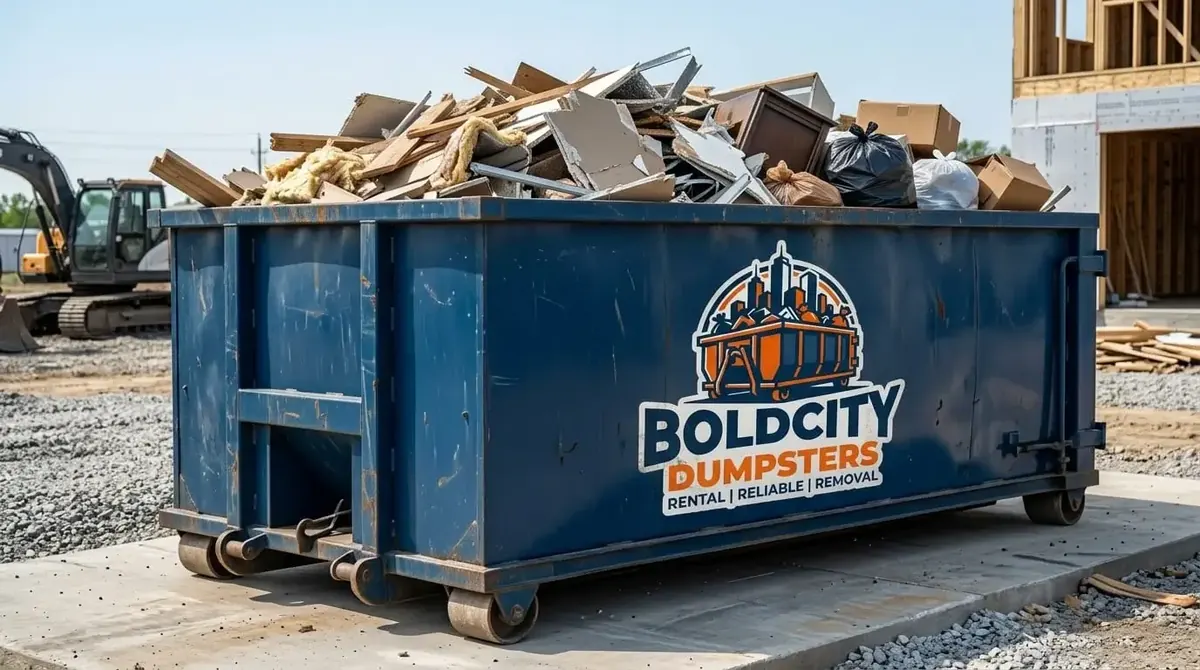
Driveway or private lot: we found no City of Jacksonville permit for a roll-off on private property; Fernandina Beach is the exception, with a temporary use permit even on private land. Jacksonville street, sidewalk or right-of-way: a right-of-way permit from Public Works under Ordinance Code §744.110 — $127 residential or $191 commercial, applied for through JaxEPICS, with a $50,000 surety bond on file for the contractor and a Maintenance of Traffic plan where traffic is affected. State roads: no FDOT permit path for a roll-off. The Beaches, Baldwin and the counties: each has its own right-of-way rule, set out below. Who may haul: Jacksonville requires a City franchise for commercial trash but not for construction debris or residential work; Clay, St. Johns and Nassau each license haulers in their unincorporated areas; and four cities run exclusive or city-controlled systems. We're licensed and insured.
Ordinance Code §744.110(a) makes it unlawful for anyone "to disturb, excavate, block, obstruct, tamper with or place any construction or other material on or in a public road, right-of-way or easement of the City without a permit from the Director of Public Works." The City's Right of Way Permitting page says the same and adds that the owner "must insure that any work or materials storage within a city right of way … has a valid city Right of way Permit." The City's pages never name dumpsters, and we found no dumpster-specific permit — the general right-of-way permit is the one that applies.
The fees, from the City Fees page: Residential R/W Permit $127.00; Commercial R/W Permit $191.00 — "automatically doubled" when work starts before a valid permit is issued. Applications go through JaxEPICS to the Development Services Review Group, Ed Ball Building, 214 N. Hogan St., 2nd floor, (904) 255-8310. For right-of-way work other than a residential driveway, §744.110(c)(2) requires an annual surety bond or letter of credit of $50,000 on file, and a contractor "must have an approved Maintenance of Traffic (MOT) plan for any work or equipment storage that will effect vehicular or pedestrian traffic." The permit itself carries the conditions — §744.110(a) lets the Director set the time for completion and the safety measures — and we found no separate Jacksonville rule on dumpster lights, reflectors or a fixed number of days in the street.
Skipping it is not cheap. The City says failure to obtain a permit "may result in a fine of not more than $250 or imprisonment of not more than ten days or both," and each day counts as a separate offense. Under §746.102, "The Sheriff may remove an unlawful encroachment or obstruction from a street, park or other public place."
Plenty of Jacksonville streets are not City streets at all. Our own yard sits on Edgewood Avenue North, which FDOT's road data lists as State Road 111. The City's permit page says you do not need a City right-of-way permit on FDOT right-of-way and points you to FDOT at (904) 360-5200. But FDOT gives no way to put a roll-off there. Rule 14-20.008 lets a city or county authorize waste receptacles on a state road only if they are "no greater than 110 gallons in capacity and no taller than four feet," never on limited access roads, and never blocking a sidewalk, bike path, pedestrian path, driveway, drainage structure or ditch. Rule 14-20.010, FDOT's General Use Permit for temporary use of the right-of-way, says permits "shall not be issued" for "waste receptacles."
Outside incorporated cities, F.S. 337.406(1) also makes it unlawful to use state right-of-way in any manner that interferes with the safe and efficient movement of people and property. So on a state road, the driveway or the lot is the answer. If you are not sure whether your street belongs to the City, the county or the state, give us the address and our team can help explain the permit requirements before delivery day.
Atlantic Beach has the most detailed rules in the area. City Code §16-8(d) limits service hours to 7:00 a.m. to 7:00 p.m., requires roll-offs to be labeled with the company name and telephone number, caps a roll-off used for concrete, soil or comparable heavy debris at 20 cubic yards, and — except in use with an active building permit — keeps containers from staying on any lot for more than ninety days. On the street: "Roll-off containers shall not be located within the city right-of-way without prior written consent of the public works director. Roll-off containers may never remain on the paved surface of any road overnight." And under §16-8(f), when a tropical storm warning or hurricane warning is declared for any part of Duval County, "all roll-off containers and construction dumpsters must be emptied or removed from the site."
Jacksonville Beach §28-20 uses the same wording as Jacksonville: nothing may block, obstruct or be placed on a public road, right-of-way or easement of the city without a permit from the director of public works. The fee is $40.00, with an annual surety bond of $1,500. Neptune Beach §18-4(a) says all proposed private use of the city right-of-way "must obtain a right-of-way permit and pay any associated permit fees." Baldwin §19-1 makes it unlawful to obstruct or encroach on the town's streets and sidewalks, but carves out "the storing of materials for the purpose of building and repairing"; §19-16 requires a written Town Council permit to obstruct or disturb a street, and §19-17 then requires barricades and "sufficient lights or flares" from half an hour after sunset to half an hour before sunrise. We found no Baldwin rule written for roll-offs.
In unincorporated Clay County — Fleming Island and Middleburg — Clay Code §18-17(a) makes it unlawful to perform construction work on any county-owned road or right-of-way without a permit from the county engineer, and the County's right-of-way page says "Any work in the county right-of-way unrelated to utility work would require a right-of-way permit." Applications go through the County's Citizen Self-Service Portal (904-529-5287). The page does not name dumpsters, so keep the box on the property or ask the County first.
Green Cove Springs is specific. Under City Code §66-11(a)(9)e, roll-off containers "must be placed on private property" and not on the travel portion of any sidewalk, pedestrian path, bicycle path, street or alley "without prior authorization from the city manager or his designee," and §66-11(a)(9)b requires each container to carry the hauler's name and phone number and a serial number. Orange Park: we found no Town permit for a dumpster in the street, and Town Code §28-24(a) bans depositing refuse on any street, alley or sidewalk — so the driveway it is.
All four are unincorporated, so St. Johns County rules apply. The County's Section 30.0 says "A right of way permit is required to regulate construction or installation of any utility or placement of any temporary or permanent structure within any right of way owned by St. Johns County," and its Right-of-Way Division says the Land Development Code "requires a written permit to disturb, excavate, block, obstruct, tamper, with or place any construction or other material in any public road right-of-way." Apply through the County's ROW Use Online Permit Application.
On the job site itself, the County's solid waste ordinance (Ord. 2017-39) says construction and demolition debris "shall be placed in Mechanical Containers or Receptacles at job sites" and bans wire "pig pens" (§12.A); debris left on the ground for more than seven days is a public nuisance (§12.B); and loads must travel in a fully covered or enclosed vehicle or container (§13). A roll-off on the lot ticks all three boxes.
In unincorporated Nassau County — Yulee and the unincorporated part of Amelia Island — Ordinance 99-17 governs the "placement of any temporary or permanent structure within any right-of-way owned by Nassau County," with the application going to the County Engineer before work starts (§§8.1.1, 6.1.1). On unincorporated Amelia Island, Nassau LDC §37.02 counts "placement of dumpsters" as development activity that has to stay inside the approved limits of disturbance.
Fernandina Beach regulates the container even on private land. LDC §5.02.06 says roll-off dumpsters are permissible temporary structures, but "A temporary use permit shall be obtained"; the permit is limited to thirty days per lot per year with one 30-day renewal, or the duration of the building permit; the container "must be placed on private property, not within the right-of-way, unless a right-of-way permit has been issued"; it must sit at least one foot from any property line; and it must not obstruct pedestrian access. City Code §70-2(a) says "Encroachments in and use of the public right-of-way is prohibited without a permit," and §22-261 wants construction site dumpsters inside the fence and removed before a certificate of occupancy is issued. Callahan: we found no Town dumpster permit, and Town Code §155-2 makes it unlawful to deposit waste matter of any kind on any street, road, sidewalk, lane, alley or right-of-way.
We found no general Florida state licence for roll-off haulers; collection is set locally. In Jacksonville, Ordinance Code §380.604 requires a City franchise to provide container service for nonresidential solid waste, but exempts construction and demolition debris (§380.604(b)(5) and §380.603). The City's FAQ puts it plainly: "For waste other than construction and demolition debris and recycled materials, the company must have a franchise issued by the city." That is why our commercial work in Jacksonville is construction, renovation, fit-out and demolition debris — we do not offer ongoing commercial trash service there. Clay County requires a county franchise to haul roll-offs in the unincorporated county (App. D, Art. III §III.9); St. Johns County requires a county construction and demolition franchise (Ord. 2017-39 §4); and unincorporated Nassau County requires a solid waste hauler permit (§30½-76). Green Cove Springs requires a non-exclusive city franchise for construction and demolition roll-off service (§66-11), and Neptune Beach requires a licence from the city manager to remove garbage or trash (§11-61).
Four cities run exclusive or city-controlled systems. Fernandina Beach §66-36 reserves refuse collection to the city or a franchise granted by the City Commission. Orange Park §28-26 makes its franchise exclusive, except for "a town licensed construction cleanup contractor." Atlantic Beach (§16-13) and Jacksonville Beach (§27-42) grant exclusive garbage franchises, with a carve-out for "services not covered under the solid waste franchise contract." In those four, we check the City's or Town's rules before booking a container inside city limits. We found no franchise or roll-off rule in Baldwin's code, and Callahan's posted code covers residential garbage service (§155-5). Bold City Dumpsters is licensed and insured.
Tell us the address and where you want the box. A driveway is the simplest case almost everywhere we serve. A Jacksonville street spot takes a right-of-way permit through JaxEPICS, a bond on file and possibly an MOT plan, so give yourself extra lead time. A state road means the driveway. In Atlantic Beach, plan around the 7 a.m. to 7 p.m. service hours and any storm warning; in Fernandina Beach, the temporary use permit comes first; in Green Cove Springs, the box stays on private property unless the city manager says otherwise. If your neighborhood has an HOA, check its rules on how long a container can sit in the driveway. Call (904) 595-8110, 24 hours a day, 7 days a week.
Talk to a real person
Call (904) 595-8110 with the address and what is going in. A flat price and a delivery window before you hang up.
Open 24 hours, 7 days
From this guide
We found no City of Jacksonville permit rule for a roll-off on private property. Your HOA may still have rules, so check them. On a City street, sidewalk or right-of-way, you need a right-of-way permit from Public Works under Ordinance Code §744.110.
The City lists $127 for a residential and $191 for a commercial right-of-way permit, doubled if work starts before the permit is issued. Non-driveway work also needs a $50,000 surety bond or letter of credit on file, and a contractor needs an approved MOT plan where traffic is affected.
No. FDOT Rule 14-20.008 limits waste receptacles on state right-of-way to 110 gallons and four feet tall, and Rule 14-20.010 bars General Use Permits for waste receptacles. Keep it on the driveway or the lot.
It depends where. Jacksonville requires a City franchise for commercial trash but not for construction debris or residential work; Clay, St. Johns and Nassau license haulers in their unincorporated areas; and Fernandina Beach, Orange Park, Atlantic Beach and Jacksonville Beach run exclusive or city-controlled systems. We are licensed and insured, and we check local rules before we book.
Keep reading
The rest of the series, same approach — official sources, no filler.
Sizing
The 20 yard is our most popular all-purpose size. How to pick between 10, 15, 20, 30 and 40 yards by volume, weight and space in Jacksonville.
Read the guideCost
In many cases, Jacksonville dumpster rentals run about $350 to $750. What is inside that number, what moves it, and the published landfill and permit fees.
Read the guideGuide
Everything in one place: how a roll-off rental works in Jacksonville, sizes and weights, what the City collects, permits, storm season and where loads go.
Read the guide